Introduction – Why Choosing the Right NGO Structure Matters in Ratlam
In Ratlam, charitable and social initiatives are growing steadily. Many individuals, business families, religious groups, education promoters, and socially active citizens now wish to formalize their charitable work through a legally registered NGO. However, before starting operations, the most important decision is choosing the correct legal structure.
Most people assume NGO registration is just paperwork. In reality, the structure you choose directly affects your tax benefits, compliance requirements, credibility, CSR eligibility, audit responsibility, and long-term sustainability. A wrong decision at the beginning can create serious difficulties later, especially when applying for 12A registration, 80G approval, or CSR funding.
In Ratlam, many small trusts are formed without professional guidance, and later when income tax exemption or funding is required, they face complications. Similarly, some people unnecessarily incorporate a Section 8 Company without understanding compliance burden.
Therefore, this article explains in detail:
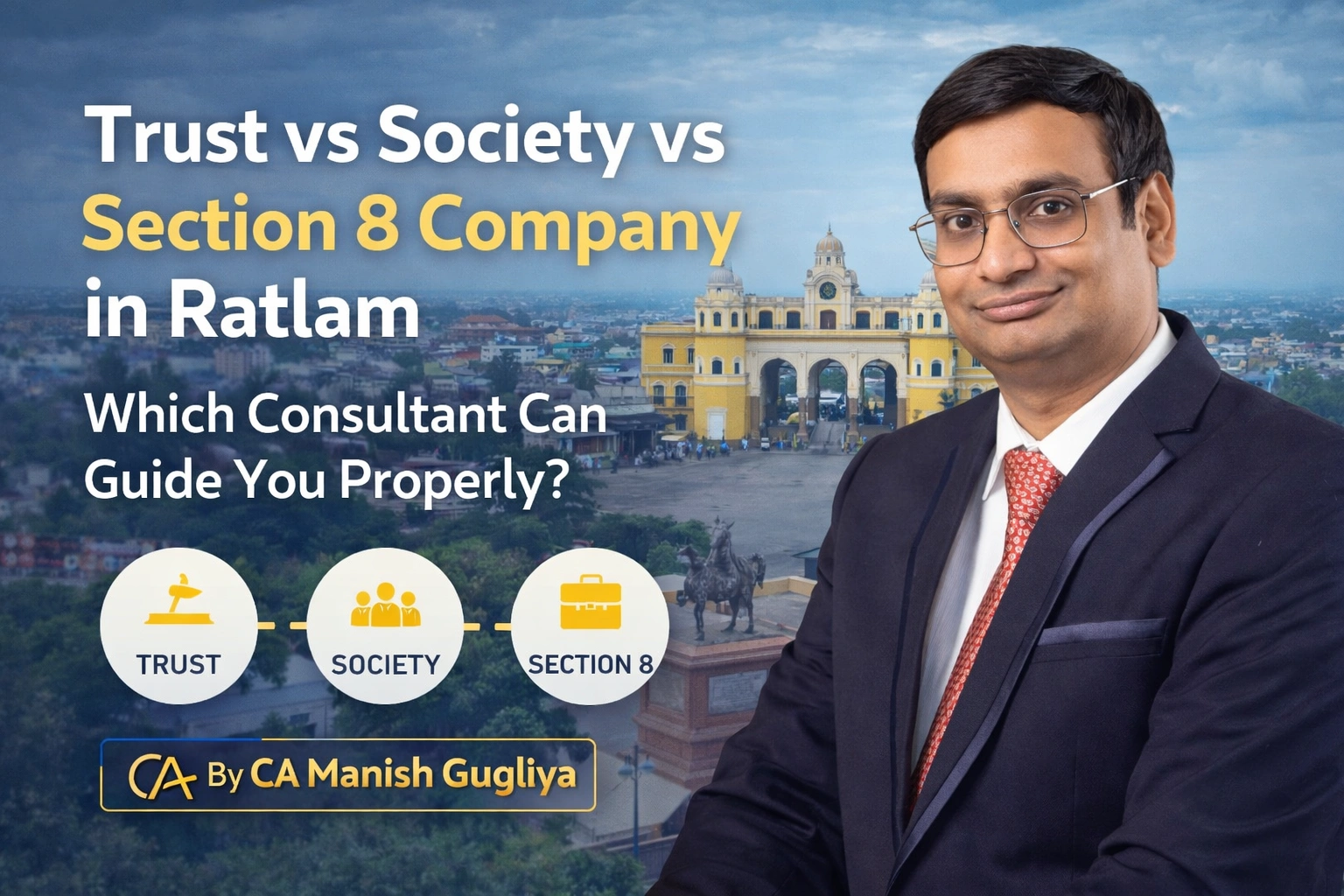
• Difference between Trust, Society and Section 8 Company
• Which structure suits which type of NGO in Ratlam
• Compliance obligations in Madhya Pradesh
• Why selecting the right NGO consultant in Ratlam is more important than just selecting a structure
Making an informed decision today can prevent compliance disputes tomorrow.
Overview of NGO Structures in India
In India, NGOs can be legally registered under three main structures:
- Public Charitable Trust
- Society
- Section 8 Company
Each structure is governed under different laws and has different levels of regulation, compliance, transparency, and credibility.
Before choosing any one of them, it is essential to understand the long-term operational implications.
What is a Public Charitable Trust?
A Public Charitable Trust in Madhya Pradesh is registered before the Registrar of Public Trust. In Ratlam, the local authority handles registration and documentation review.
Trust structure is commonly preferred in Ratlam for religious activities, temple management, small charity initiatives, and family-based philanthropic projects.
Minimum two trustees are required. The Trust is governed by a Trust Deed that defines objects, powers, trustee appointment rules, and management structure.
If you are planning to register a trust in Ratlam, you can read a detailed step-by-step guide here:
https://camanish.com/register-a-charitable-trust-in-ratlam/
That guide explains documentation, objection period, registration process, and timelines applicable in Ratlam.
Advantages of Trust
Trust registration is comparatively simple. Compliance requirements are lower compared to Section 8 Company. It is suitable for small-scale activities where governance complexity is minimal.
Limitations
Trust structure is rigid. Amendment of objects or trustee replacement may require formal documentation. Corporate donors sometimes prefer Section 8 Companies for CSR funding due to higher governance standards.
Trust is ideal when charitable activity is localized and funding expectations are limited.
What is a Society?
A Society is registered under the Societies Registration Act and requires minimum seven members. In Madhya Pradesh, societies are registered with the Registrar of Firms and Societies.
Society structure works well for educational institutions, cultural associations, welfare groups, sports clubs, and community-based organizations.
It has a democratic governance structure. Governing body members are elected periodically as per the rules defined in the Memorandum of Association and bylaws.
Societies require:
• Annual list filing
• Proper record maintenance
• Meeting minutes documentation
• Financial record keeping
Compliance is moderate. It is more structured than a trust but less regulated than a Section 8 Company.
What is a Section 8 Company?
A Section 8 Company is incorporated under the Companies Act, 2013 through the Ministry of Corporate Affairs portal.
This structure offers the highest level of credibility and transparency.
It requires:
• Minimum 2 directors
• Digital signature
• DIN registration
• MOA and AOA drafting
• MCA filing
Section 8 Companies are suitable for NGOs that plan to receive CSR funding, operate across multiple states, or require strong governance structure.
However, compliance burden is significantly higher. Annual filing with MCA, statutory audit, board meetings, and corporate governance standards must be maintained properly.
For NGOs aiming at professional scale operations, Section 8 Company offers long-term advantages.
Trust vs Society vs Section 8 Company – Detailed Comparison
Registration Authority
Trust is registered with local Registrar of Public Trust in Ratlam.
Society is registered at state level under Registrar of Societies.
Section 8 Company is registered centrally through MCA.
Minimum Members
Trust requires minimum 2 trustees.
Society requires minimum 7 members.
Section 8 requires minimum 2 directors.
Compliance Level
Trust has comparatively lower compliance.
Society has moderate compliance.
Section 8 has structured and high compliance.
CSR Funding Eligibility
Section 8 Companies are generally preferred by corporate donors due to compliance transparency.
Transparency and Public Image
Section 8 Company has highest credibility, followed by Society, then Trust.
This comparison clearly shows that decision should depend on scale of operations and funding plans.
Which Structure is Best for NGOs in Ratlam?
Small Religious or Family Charitable Activities
If activity is limited to local temple, religious events, or community service within Ratlam, Trust structure is practical.
Educational Institutions
Society or Section 8 Company is better because governance transparency is important for institutions.
CSR-Oriented NGOs
If the objective is to receive funding from companies under CSR provisions, Section 8 Company is usually recommended.
NGOs Planning 12A and 80G Registration
Regardless of structure, income tax registration under Section 12A and approval under Section 80G is crucial.
If you want a detailed practical guide for 12A registration in Ratlam, refer to:
https://camanish.com/how-to-apply-for-12a-registration-for-trust-in-ratlam/
This explains documentation, filing process, and common objections faced during approval.
Common Mistakes People in Ratlam Make
Many applicants choose Trust only because it is cheaper initially, without understanding future funding plans.
Some do not plan for 12A and 80G registration at the time of drafting objects. Later, applications get rejected due to improper object clause.
Some hire unqualified agents who do not understand income tax provisions.
Improper drafting and poor compliance later create serious complications.
These mistakes can be avoided with proper advisory support.
Why Choosing the Right Consultant in Ratlam is More Important Than Structure
Structure selection is important, but professional guidance determines success.
An experienced NGO consultant in Ratlam should have:
• Knowledge of MP Public Trust procedures
• Society registration experience
• Section 8 incorporation expertise
• Income Tax Act understanding
• 12A and 80G filing experience
• Audit capability
NGO compliance is closely linked with income tax provisions. If books of accounts are not properly maintained, exemption may be denied.
If you are looking for income tax advisory support in Ratlam, you may also explore:
https://camanish.com/best-income-tax-consultant-in-ratlam/
Because NGO compliance and taxation go hand in hand.
CA vs Advocate vs Agent – Who Should You Choose?
Advocate
Advocates are strong in drafting legal documents but may not manage tax compliance and audit responsibilities.
Agent
Agents may provide low-cost registration services but often lack knowledge of income tax and compliance.
Chartered Accountant
A Chartered Accountant provides integrated support:
• Registration guidance
• 12A and 80G filing
• Audit
• Income tax return
• Compliance planning
• Notice handling
For long-term sustainability of NGO, professional financial and tax advisory is critical.
Checklist – How to Choose NGO Consultant in Ratlam
Before finalizing any consultant, verify qualification, practical experience, and compliance knowledge.
Ensure written engagement and clarity of scope.
Check whether the consultant supports post-registration compliance.
Avoid consultants offering extremely low pricing without compliance support.
Professional advisory is an investment, not an expense.
Step-by-Step Process to Register NGO in Ratlam (With Proper Guidance)
First finalize appropriate structure based on objectives.
Then draft deed or MOA carefully, ensuring objects are aligned with income tax provisions.
File registration application with appropriate authority.
Obtain PAN for the NGO.
Open dedicated bank account.
Apply for 12A registration.
Apply for 80G approval.
Maintain books of account from day one.
Conduct audit wherever applicable.
File income tax return annually.
Each step requires accuracy and documentation discipline.
Real Practical Scenario in Ratlam
Case Example 1
A trust was registered without proper drafting. During 80G application, income tax department raised objection due to improper charitable object wording.
Case Example 2
A society failed to maintain annual filings. Later when applying for grant, documentation deficiency created delay.
Case Example 3
A Section 8 Company formed with proper advisory received CSR funds smoothly due to clean compliance record.
These practical examples highlight the importance of structured guidance.
Frequently Asked Questions
Which is better Trust or Section 8 Company in Ratlam?
It depends on scale of operations and funding expectations.
Is audit compulsory for NGO?
If registered under 12A and income exceeds prescribed limit, audit is mandatory.
Can Trust convert into Section 8?
Fresh incorporation is required.
Which structure is best for CSR funding?
Section 8 Company is generally preferred.
Conclusion – Structure is Important, But Consultant is More Important
Choosing between Trust, Society, and Section 8 Company is a strategic legal decision. However, long-term success of an NGO in Ratlam depends more on compliance discipline and professional guidance than on the structure itself.
The right consultant ensures:
• Proper documentation
• Tax exemption approval
• Smooth audit process
• Compliance stability
• Funding readiness
Instead of focusing only on initial registration cost, focus on sustainable compliance.
About the Author
CA Manish Gugliya
FCA, DISA, M.Com, B.Com
Practicing since 2006
Specialized in Trust Registration in Ratlam, Society Registration, Section 8 Company Incorporation, 12A & 80G Registration, NGO Audit & Compliance, and Income Tax Advisory.