
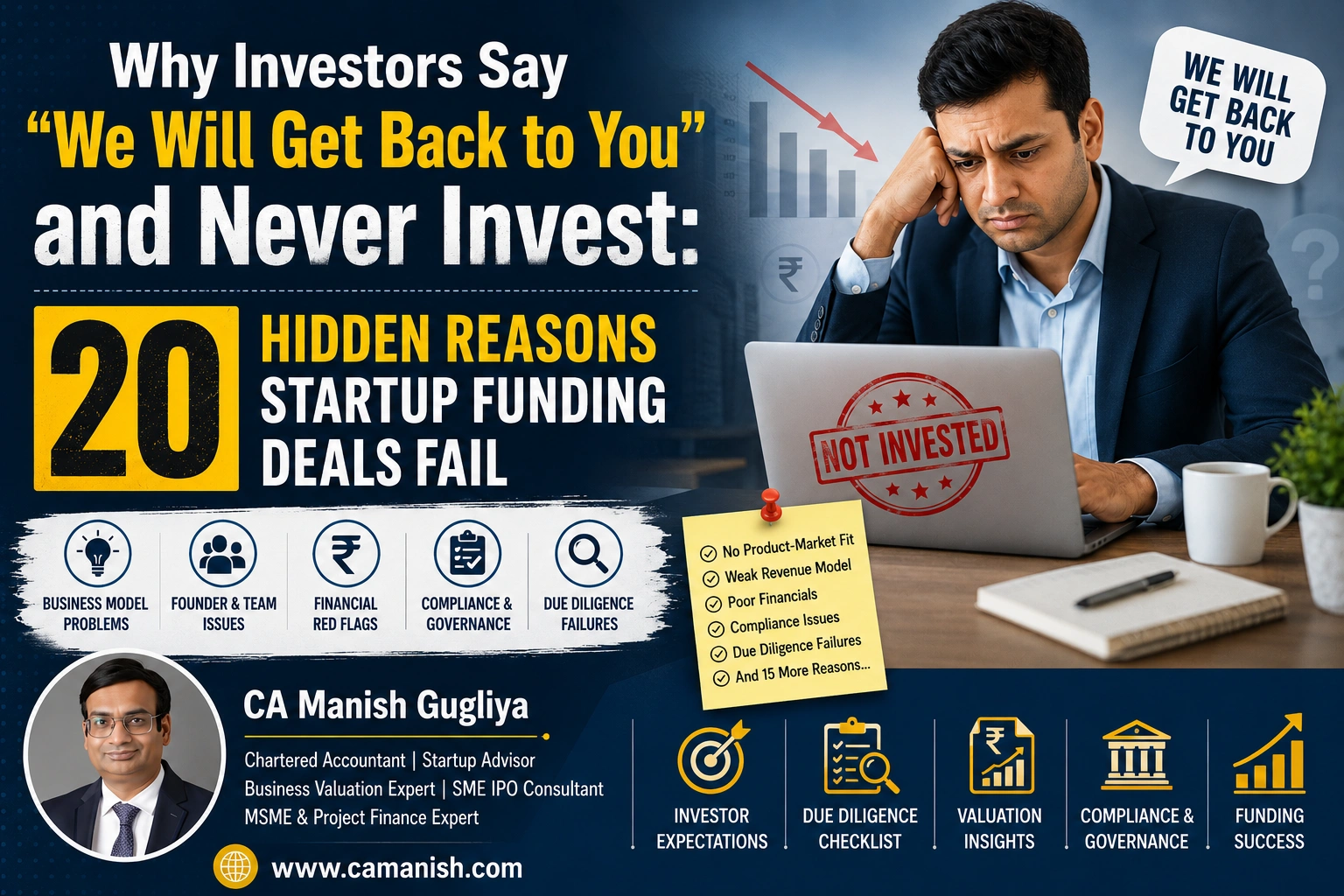
Key Takeaways
Many good startups in 2024–2026 still see their startup funding failed despite having a great idea, strong early users, and genuine innovation. The problem is rarely the idea itself-it’s almost always about investor readiness, business model clarity, and product market fit.
- Most funding rejections come from weak unit economics, missing documentation, unrealistic valuation, or poor governance-not from a bad idea.
- Venture capitalists quickly filter deals using a mental checklist: market size, early traction, founding team strength, business model scalability, compliance, and documentation readiness.
- First time entrepreneurs often misunderstand vague feedback like “We will get back to you” and treat it as hope instead of a soft “no.”
- 70-90% of startups fail within the first few years, and a brilliant idea cannot survive poor execution.
- This article provides 20 hidden reasons funding deals fail, a practical due diligence checklist, an investment readiness scorecard, and Indian case studies to turn rejection into real progress.
Introduction: When Startup Funding Failed Despite a Great Idea
Picture this: a 2025 Indian SaaS startup with 500 active users, a working product, and a passionate founding team. They pitch investors for six months. Every meeting ends with “impressive-we’ll circle back.” No one invests.
This scenario plays out thousands of times each year. In India and globally, more than 90% of startups fail to raise meaningful external funding from venture capital or angel investor sources, even when the idea is solid. According to CB Insights, 35% of startups fail due to lack of market need, while 38% of startups fail due to running out of cash. Common reasons startups fail to secure funding include weak business model, lack of market fit, poor documentation, unrealistic valuation, and governance gaps.
This article dissects why investors say “we will get back to you” and never invest, unpacking 20 specific funding failure reasons rooted in real investor psychology. Whether you’re building in SaaS, D2C, manufacturing, AI, or MSME sectors-this is the research-backed playbook most entrepreneurs never get.

Why Investors Say “We Will Get Back to You” But Never Do
“We’ll get back to you” is almost always a polite rejection, not an invitation to wait. Investors receive hundreds of pitches weekly. Many pitches are rejected by investors in under a minute. They default to soft, non-committal language to preserve relationships, avoid legal risk, and save valuable time.
As Y Combinator partner Tom Blomfield explains, many rejections are about the founder or team “not being impressive enough”-but investors will almost never admit that directly. Roughly 85% to 90% of investor rejections are due to being too early for the fund’s investment thesis.
Hidden meanings behind common phrases:
| Phrase | What It Really Means |
|---|---|
| “Too early for us” | Insufficient traction or revenue |
| “Keep us posted” | We’re not convinced, but don’t want to burn bridges |
| “Circle back next round” | Your market or model doesn’t excite us now |
| “Interesting space” | We like the category but not your approach |
| “We need more data” | Your numbers don’t support the story |
Signals that it’s actually a “no”: No follow-up questions, no data requests, no second meeting scheduled, and only generic feedback.
20 Hidden Reasons Startup Funding Deals Fail
This core section covers specific, non-generic reasons why startup funding failed even when a great idea existed. Each reason reflects real startup funding challenges seen in India between 2018 and 2026 across SaaS, D2C, manufacturing, AI era ventures, and MSME businesses. First time entrepreneurs typically face several of these simultaneously, compounding the risk perception for venture capitalists.
1. No Clear Product Market Fit
Product market fit means customers repeatedly buy, retention is strong, and willingness to pay is clear-not just downloads or sign-ups. Investors treat premature scaling without market fit as a huge mistake. Notably, 54% of founders learned the importance of product-market fit from failure.
Indian example: A 2023 B2B HR-tech platform had pilots with four companies but zero paying users. Investors passed repeatedly.
Warning signs: High churn, constant discounting, customer confusion about value.
Fix: Narrow your target market, run customer interviews, test pricing, and delay large fundraising until basic retention and revenue metrics are visible.
2. Weak or Unscalable Business Model
Venture capitalists avoid models dependent on manual work, low margins, or one-off project revenue. They want scalable, repeatable, profitable unit economics. Notably, 72% of founders believe a better business plan improves their odds of building a successful company.
Example: An Indian services-heavy edtech startup was rejected because revenue depended on custom projects, not recurring subscriptions.
Fix: Show subscription models, standardized offerings, automation paths, and clear gross margin targets in your pitch deck.
3. Small or Poorly Defined Market Size
Venture capitalists seek businesses that can reach ₹500–700 crore annual revenue within 7–10 years. Confusing TAM with actual serviceable obtainable market is a common mistake.
Example: A regional B2C app targeting only one city with no credible expansion strategy caused VCs to pass.
Fix: Show adjacent segments, geography expansion, and digital adoption trends with bottom-up sizing.
4. Early-Stage Traction Too Weak or Inconsistent
Investors look for companies that can bootstrap or use early revenue to show viability. Flat month-on-month growth or spike-then-drop patterns signal trouble.
Example: A 2024 SaaS startup showed only 2–3 pilot customers over 12 months-investors inferred slow market acceptance.
Fix: Define 3–5 core traction metrics, set monthly targets, and showcase cohort-level early traction over at least 6–9 months. Send quarterly traction updates to potential investor contacts even before they commit.
5. Founding Team Gaps and Execution Risk
For early stage startups, investors bet more on the team than the product. Investors often reject startups due to team concerns-a strong team can significantly influence startup success, while team dynamics impact decision-making and execution speed.
Red flags: Solo non-technical founder for a deep-tech product, co-founder conflicts, high attrition. Hiring the wrong team can damage startup culture, and 49% of founders wish they had hired key team members sooner.
Fix: Bring in missing co-founders, define clear roles, and show a credible hiring roadmap. Address coachability, resilience, and domain expertise in your narrative.
6. Over-Optimistic or Unrealistic Financial Projections
Hockey-stick revenue graphs without unit-economics backing create instant distrust. Standard budgeting fails in hypergrowth scenarios-investors know this.
Example: A D2C brand projecting ₹0 to ₹100 crore in 3 years with no clear customer acquisition plan.
Fix: Build bottom-up models with scenario analysis (base, best, worst), sales funnel logic, and realistic CAC assumptions.
7. Startup Valuation Mistakes
Excessive valuation demands-especially pre-revenue-cause angels and VCs to walk away. Misunderstanding pre-money vs post-money and ignoring dilution effects are common startup valuation mistakes.
Example: A pre-revenue AI startup in Bengaluru insisted on a US$20M valuation because of the “AI boom.” Every potential investor passed.
Fix: Use scorecard or Berkus methods, reference comparable Indian deals, and get a professional valuation review from a CA before approaching institutional investors.
8. Weak or Confusing Pitch Deck
Investors often form views in 3–5 minutes from the deck alone. Developing a strong pitch deck clearly outlines the problem and solution-and missing this step is fatal.
Slide order: Problem → Solution → Market → Business Model → Traction → Competition → Team → Financials → Ask → Use of Funds.
Fix: Include real data, client logos, traction charts, and concise investor-friendly language. Avoid buzzwords and generic “huge market” claims.
9. Poor Understanding of Competition
Investors often reject startups lacking a competitive edge. Saying “we have no competitors” signals naivety-founders often fail to recognize technological disruptions or competitors that may already serve the same target market differently.
Competition and market dynamics cause 45% of pivots, and 44% of pivots are due to technology or product issues.
Fix: Map direct, indirect, and substitute competitors. Use a competitive matrix showing price, speed, and defensibility.
10. Unscalable or Capital-Heavy Operations
Asset-heavy models (owning warehouses, vehicles, manufacturing plants) may not suit venture capital. VCs prefer asset-light, tech-enabled platforms.
Example: A hyperlocal delivery startup owning all vehicles rather than using an aggregator model faced funding hesitation.
Fix: Consider leasing, partnerships, platform models, or alternate funding like project finance for heavy assets.
11. Poor Financial Management and High Burn Rate
Running out of cash is a primary reason many startups fail. Startups frequently mismanage their burn rate, and running out of cash often starts months before zero balance. Underestimating burn rate can lead to catastrophic cash flow problems. According to Startups.com, 38% of startups fail due to cash issues.
Fix: Create a 12–18 month cash flow plan, monthly MIS, and hire a CA or CFO-level advisor to establish financial discipline before approaching venture capitalists.
12. Regulatory, Legal, or Compliance Risks
Many investors walk away from startups with poor ROC filings, GST non-compliance, or unresolved legal disputes. Unexpected tax bills can disrupt cash flow significantly.
Example: A lending fintech whose funding failed because KYC, data privacy, and NBFC collaboration agreements were incomplete.
Fix: Conduct a compliance health check before serious fundraising. Ensure MCA filings, GST returns, TDS, PF/ESI, and sectoral licenses are current.
13. Weak Governance and Cap Table Issues
Messy cap tables, informal equity promises, and commingling personal and business expenses discourage venture capitalists.
Fix: Clean the cap table, formalise shareholder agreements, implement basic governance policies, and avoid giving large equity chunks to advisors without vesting.
14. Misalignment with Investor Thesis or Stage
Every venture capitalist has an investment thesis: sector, geography, ticket size, stage. Researching and targeting the right investors aligns with a startup’s growth stage. Many good startups receive a “no” simply because they don’t fit the fund’s mandate.
Fix: Use platforms like AngelList, Crunchbase, or Indian databases to filter by thesis. Maintain an investor CRM with sector focus, cheque size, and stage fields.
15. Portfolio Conflict and Market Saturation
Investors avoid backing two competing startups in portfolio companies. Saturated categories reduce funding chances unless differentiation is exceptional.
Fix: Research investor portfolios before meetings to avoid wasting valuable time and revealing sensitive information.
16. Poor Communication and Weak Investor Meetings
Unclear communication signals poor leadership. Founders who spend 25 minutes on vision but only 2 minutes on revenue lose investor confidence immediately.
Fix: Time-box the pitch, prepare crisp answers on revenue and margins, and practice with mentors before live meetings.
17. Over-Negotiation, Ego, and Behavioural Red Flags
Investors imagine working with startup founders for 7–10 years-they avoid difficult personalities even if numbers look good.
Fix: Focus on balanced negotiation, listening, and long-term partner thinking. Get an experienced advisor who can negotiate firmly but professionally on your behalf.
18. External Factors and Market Cycles
Macro factors like interest rates, sector scandals, and funding winters can freeze money even for strong companies. 25% of startups fail due to technology or product issues compounded by external factors and tough times.
Example: The 2022–2023 funding winter in Indian edtech and quick commerce delayed or killed otherwise viable rounds.
Fix: Extend runway, explore venture debt or project finance, and refine milestones to align with the next funding window. Don’t take every “no” personally-sometimes it’s timing, not quality.
19. Incomplete Documentation and Due Diligence Readiness
Many term sheets fall through during due diligence because financial statements, GST returns, and contracts are missing or inconsistent. Maintaining a well-organized data room is important for due diligence.
Fix: Create a data room with all key documents sorted and updated 1–2 months before serious investor discussions.
20. Lack of Clear Use of Funds and Milestone Plan
Investors fund milestones, not ideas. Defining measurable milestones builds investor confidence. Vague asks like “marketing” or “hiring” without linkage to growth outcomes signal poor planning.
Fix: Split the fund ask into buckets (product, sales, marketing, operations, runway) and attach measurable 12–18 month goals.
How Investors Actually Evaluate Startups (From First Email to Cheque)
Understanding the investor evaluation funnel helps founders prepare and reduces chances of startup funding failed at late stages.
| Stage | What Investors Check | Founder Action |
|---|---|---|
| Initial Screening | Sector fit, stage, geography, team background | Sharp email, concise deck, core numbers on first slides |
| Pitch Deck Review | Problem, solution, market, model, traction consistency | Include MRR, growth rate, retention, burn rate |
| Founder Meeting | Clarity, coachability, grasp of numbers | 10–12 min structured pitch, honest Q&A |
| Market Evaluation | Market size, growth trends, regulatory environment | Share own research, customer feedback proactively |
| Financial Review | CAC vs LTV, margins, payback, runway | Clean financial model with listed assumptions |
| Due Diligence | Financial, tax, legal, compliance verification | Complete data room, reconciled numbers |
| Investment Committee | Opportunity summary, risks, terms | Ensure deck and model can speak without you |
| Term Sheet | Valuation, equity, rights, ESOP, vesting | Seek legal and CA input on long-term implications |
| Closing | SHA, SSA, conditions precedent, fund transfer | Maintain closing checklist, transparent communication |
10 Questions Investors Ask Before Investing
Founders who actively seek funding should rehearse these questions. Each tests a different dimension of startup investment readiness.
- What precise problem are you solving, and for whom? – Use real data, not buzzwords.
- Why is now the right time? – Reference specific catalysts (UPI adoption, AI breakthroughs, regulatory shifts).
- How big can this get in 7–10 years? – Bottom-up market sizing, not generic global TAM.
- Why are you and your team the right people? – Domain experience, past execution, lived problems.
- Who are your top three competitors, and why will you win? – Honest mapping of direct and indirect competition.
- What traction have you achieved? – 6–12 months of consistent metrics, not vanity spikes.
- How do you make money, and what are your unit economics? – CAC, LTV, gross margin, payback period.
- What are the biggest risks and mitigations? – Realistic risk assessment builds trust.
- How much are you raising, and what milestones will this capital achieve? – Specific buckets tied to outcomes.
- What is your long-term vision and possible exit path? – Acquisition, strategic sale, or SME IPO possibilities.
Common Mistakes During Investor Meetings
- Communication: Talking in jargon, overloading slides, reading from slides, not structuring the pitch clearly.
- Neglecting numbers: Over-focusing on vision while unable to recall revenue, margin, or churn numbers. Keep a one-page metrics snapshot handy.
- Valuation errors: Anchoring at unrealistic valuation and arguing emotionally. Use benchmarks from comparable Indian deals.
- Poor etiquette: Arriving late, interrupting investors, not sending follow-up within 24 hours. Investors assess professionalism as a proxy for future boardroom conduct.
Startup Due Diligence Document Checklist
Missing documents are among the most common reasons startup funding failed after term sheet stage. Share this list with your CA, CS, and legal advisor.
| Category | Key Documents |
|---|---|
| Corporate & Legal | Certificate of Incorporation, MOA/AOA, PAN, TAN, GST Registration, Cap Table, SHA, SSA, Board Minutes |
| Financial & Tax | Audited financials (3 years), MIS, GST returns, TDS returns, ITR, Bank statements, Related-party schedules |
| Commercial | Customer contracts, LOIs, Vendor agreements, SLAs, Top 10–20 customer/vendor summaries |
| HR & Founders | Founder agreements, Employment contracts, NDAs, ESOP scheme, Vesting schedules, PF/ESI records |
| IP & Technology | IP assignments, Software licences, Patents/trademarks, Privacy policies, Tech architecture docs |
| Litigation & Compliance | Pending litigations, Tax notices, Compliance certificates, Regulatory approvals |
Startup Investment Readiness Scorecard
Use this self-assessment before approaching venture capitalists. Score each dimension 1–5 (1 = not ready, 5 = fully ready).
| Dimension | Score (1-5) | What “5” Looks Like |
|---|---|---|
| Product Market Fit | Paying customers, low churn, clear value proposition | |
| Business Model Scalability | Recurring revenue, positive unit economics | |
| Market Opportunity | ₹500 Cr+ addressable, growing, quantified | |
| Founding Team | Complementary skills, full-time, domain expertise | |
| Financial Hygiene | Audited accounts, 18-month projections, controlled burn | |
| Compliance & Legal | All filings current, no disputes, licences in order | |
| Governance | Clean cap table, board structure, ESOP documented | |
| Documentation | Complete data room, reconciled numbers | |
| Traction Quality | 6+ months consistent growth, retention metrics | |
| Funding Plan Clarity | Clear use of funds, milestones tied to capital |
How to use: Score honestly, identify anything below 3, and create a 90-day improvement plan before serious fundraising.
10 Red Flags That Instantly Kill Funding
- Fabricated or inflated numbers – Investors prefer bad but honest numbers over fake good numbers.
- Hidden legal or regulatory issues – Surprise discoveries are worse than known problems.
- Founder disharmony or impending departures – Investors rarely back teams with unresolved co-founder disputes.
- “No competition” claims – Signals poor market research to experienced investors.
- Extreme valuation without justification – Over-valuation now harms future rounds.
- Non-serious or part-time founders – Lack of commitment equals high execution risk.
- Messy cap table with unclear ownership – Delays or kills deals during legal due diligence.
- Ignoring or arguing aggressively with feedback – Low coachability is a dealbreaker.
- Regulatory non-fit business models – Especially critical in fintech, healthtech, and gaming in India.
- No clear exit possibility – If investors can’t imagine liquidity (acquisition, SME IPO, strategic sale), they won’t invest.
Practical Case Studies: When Startup Funding Failed – And What Changed

SaaS Startup: Weak Documentation Kills a Term Sheet
A Bengaluru B2B SaaS company (2019–2021) with ₹1 crore ARR received a term sheet but funding failed due to messy GST and ROC filings. After hiring a CA, cleaning accounts, and establishing compliance discipline, they raised a smaller round from another fund in 2022. Lesson: Keep financials clean from day one.
Manufacturing MSME: Wrong Capital Type, Right Business
A Jaipur precision components manufacturer with steady profits sought venture capital for plant expansion in 2020. VCs rejected it-capital-intensive, moderate growth doesn’t fit VC models. The company later secured project finance and explored SME IPO readiness. Lesson: Choose funding type aligned with your business model.
D2C Brand: Over-Valuation and Traction Gaps
A Mumbai D2C personal care brand had ₹50 lakh monthly revenue but high returns and low repeat purchase. Investors flagged poor product market fit. After focusing on product quality and retention, founders raised at a reasonable valuation in 2025. Lesson: Fix unit economics before chasing headlines.
AI Startup: Hype Without Revenue
A 2022–2024 Hyderabad AI analytics startup had strong demos but no paying customers-yet demanded sky-high valuation. After 12 months focusing on one niche use case and signing 10 paying clients, they raised a sensible seed round. Lesson: Even in the ai era, you need revenue, not just technology demos.
Traditional MSME: Governance Upgrade Unlocks Funding
A Delhi family-owned trading MSME with ₹40 crore revenue faced rejection due to commingled accounts and informal contracts. After professionalising governance, formalising contracts, and building board structure, they attracted investor interest in 2022. Lesson: Governance matters as much as growth for entrepreneurship success.
Putting It All Together: Turning “Funding Failed” into Investor Readiness
Most funding failures come from predictable, fixable issues-not from idea weakness. Use the 20 reasons, due diligence checklist, and readiness scorecard above to audit your startup honestly.
Next steps: Refine your business model, clean compliance, prepare a strong data room, and restart investor outreach with better targeting. One-third of startup founders raise money from friends and family before institutional rounds-there’s no shame in creative capital strategy while you build readiness.
Related Articles: Business Valuation | Startup Valuation | Due Diligence Checklist | SME IPO Guide | Financial Modelling | Corporate Governance | Startup Compliance
Many founders who eventually built a successful company faced multiple rejections first. The difference wasn’t luck-it was preparation, focus, and willingness to receive guidance and act on feedback.
FAQs on Why Startup Funding Failed (And How to Recover)
How many investor rejections are “normal” before a startup gets funded?
Even strong startups may face 20–50 rejections before closing a round. Track patterns in feedback rather than count rejections. Persistent but iterative outreach-where you refine your pitch and traction between cycles-is far more effective than mass, unchanged pitching to every angel investor or VC you can find.
Should I pause fundraising and focus on traction if my funding round has failed?
If multiple investors flag similar issues around traction, market fit, or unit economics, it is wise to pause, fix fundamentals, and return stronger. Prioritise revenue, customer validation, and product improvements during the pause. Stronger traction almost always leads to better valuation and faster closes. In fact, 81% of successful founders pivot based on data, 57% of founders made a major pivot or multiple pivots, and 42% of founders wished they had pivoted sooner.
Is venture capital the only way to fund my startup if VCs keep rejecting me?
Absolutely not. Other options include bootstrapping, revenue-based funding, angel investors, bank loans, project finance, and SME IPO for mature MSMEs. Align funding source with your business type-asset-heavy manufacturing may suit debt or project finance better. Don’t chase VC money as a status symbol if it doesn’t fit your model. Investors who are actively investing in your sector and stage are the only ones worth pursuing.
When should a startup consider pivoting after repeated funding failures?
If there is consistent market feedback showing low demand or poor unit economics, a pivot may be wiser than forcing the original idea. Use customer interviews, churn data, and failed sales cycles as indicators-not just investor opinions. Many successful Indian companies found success after pivoting. Competition and market dynamics cause 45% of pivots, and 81% of founders pivoted from their original idea at least once. As any advisor at harvard business school would explain, the strategy that works is the one validated by real customers.
Do I need a CA or financial advisor before approaching investors?
Yes-involving a CA or experienced advisor early helps prepare financials, projections, valuation, and compliance before serious fundraising. Professional support reduces due diligence issues and helps you answer investor questions with confidence. This is particularly important for Indian startups dealing with GST, ROC, and complex share structures where new capital depends entirely on clean documentation.
About the Author
CA Manish Gugliya is a Fellow Chartered Accountant (FCA) with extensive experience in startup advisory, business valuation, SME IPO readiness, project finance, MSME consulting, financial due diligence, and entrepreneurship. Through camanish.com, he shares practical insights on startup funding, SME IPOs, taxation, business strategy, compliance, and financial management to help founders build investment-ready and sustainable businesses.
- मुद्रा लोन रिजेक्शन के कारण – बैंक किन वजहों से आवेदन अस्वीकार करते हैं? (Complete Guide)

- क्या नया बिजनेस होने की वजह से मुद्रा लोन रिजेक्ट हो सकता है?
- मुद्रा लोन रिजेक्शन में बैंक की इंटरव्यू और चर्चा कितनी महत्वपूर्ण होती है?
- बैंक आपके व्यवसाय की व्यवहार्यता (Business Viability) कैसे जांचता है? [CA की complete लोन गाइड]
- मुद्रा लोन रिजेक्ट होने में बैंक की Internal Credit Policy की क्या भूमिका है?
- क्या पहले किसी बैंक द्वारा रिजेक्ट किया गया मुद्रा लोन आवेदन नए आवेदन को प्रभावित करता है? (2026)
- मुद्रा लोन आवेदन रिजेक्ट होने से पहले बैंक किन बातों की अंतिम जांच करता है?
- मुद्रा लोन आवेदन की कौन-कौन सी गलतियाँ रिजेक्शन का कारण बनती हैं?
- अच्छा CIBIL Score होने पर भी मुद्रा लोन क्यों रिजेक्ट हो सकता है? (2026)
- मुद्रा लोन रिजेक्ट होने का असली कारण कैसे पता करें? पूरी गाइड (2026)
- Why One Large Customer Can Reduce Your Business Valuation (2026 Guide)

- How to Prepare Your Company for an SME IPO in India (2026): Practical Guide by a Chartered Accountant


- Why Investors Say “We Will Get Back to You” and Never Invest: 20 Hidden Reasons Startup Funding Deals Fail

- मुद्रा लोन से चाय की दुकान कैसे शुरू करें? – पूरी जानकारी

- मुद्रा लोन से ब्यूटी पार्लर खोलना: आकर्षक और प्रेरणादायक गाइड
