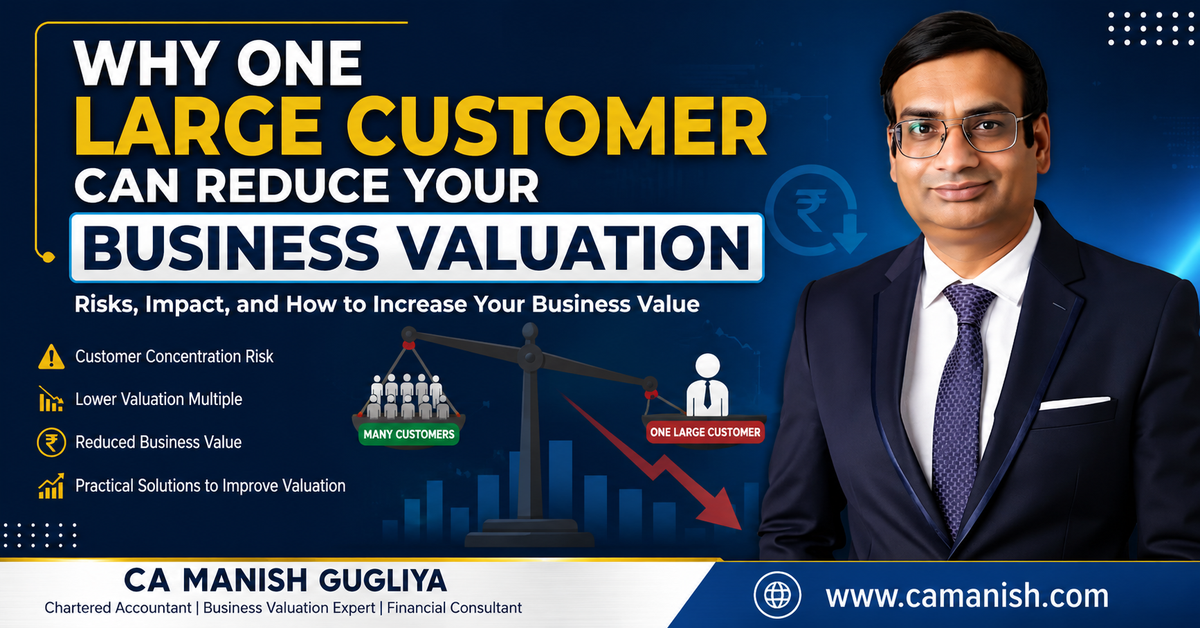
Key Takeaways
- Two businesses with the same ₹10 crore revenue and ₹2 crore EBITDA can receive very different valuations if one depends on a single customer for 80% of sales while the other serves 300 customers.
- High customer concentration risk almost always leads to a lower EBITDA multiple and tighter deal structure-including earn-outs, holdbacks, and escrow-in India and globally.
- Investors, lenders, and SME IPO investors closely measure customer concentration percentage during due diligence and adjust valuation for it. Most buyers prefer no single customer over 10% of revenue.
- MSME and family business owners can improve valuation within 18–24 months by diversifying the customer base, formalising multi year contracts, and reducing dependence on promoter-only customer relationships.
Introduction: One Customer, Two Very Different Valuations
Imagine two companies. Both generate ₹10 crore in annual revenue. Both earn ₹2 crore EBITDA. Company A serves around 300 customers. Company B earns 80% of its revenue from just one client. If you were an investor, which company would you value higher-and why?
The answer is almost always Company A. Valuation is not only about revenue and profit. It is equally about how predictable revenue is, how stable the cash flow stream will be, and how resilient the business is if something changes. Revenue concentration from a few customers makes future earnings uncertain, and uncertainty reduces value.
Customer concentration risk is one of the most common reasons MSMEs in India receive lower-than-expected offers from investors or potential buyers. In my 20-plus years advising businesses on valuation and corporate finance, I have seen heavy dependence on one or two major customers cause more valuation surprises than short-term profit fluctuations ever do.
This guide explains how one large customer can drag down your business valuation-and what you can practically do about it before fundraising, succession planning, or an SME IPO.
What Is Customer Concentration Risk?
Customer concentration is the share of total revenue coming from your largest one, three, five, or ten customers. Customer concentration risk is the vulnerability created when that share is high. You can calculate customer concentration risk simply: if one customer contributes ₹3 crore out of ₹12 crore in total sales, your top customer concentration percentage is 25%.
Related concepts matter here. Customer dependency refers to heavy reliance on a few key accounts. Relationship depth describes how broad and institutionalised the customer relationship is-is it managed by a team or held solely by the promoter? And customer base refers to your overall mix and number of active customers.
What is considered high customer concentration? Across multiple valuation advisory sources, a single customer over 10% of revenue is a red flag. Buyers prefer no single customer to exceed 5-10% of total revenue. Top five customers contributing over 30% of ARR raises red flags, and top five customers should not exceed 30-40% of ARR for a healthy revenue distribution.
| Concentration Level | Top Customer % | Top 5 Customers % | Risk Comment |
|---|---|---|---|
| Low concentration | Below 10% | Below 25% | Strong diversification; most buyers are comfortable |
| Moderate | 10–20% | 25–40% | Manageable, but needs monitoring |
| High | 20–30% | 40–60% | Material risk; valuation discount likely |
| Critical | Above 30% | Above 60% | Severe risk; significant discount and stricter terms |
In Indian MSMEs, critical concentration is common. Consider an auto-component supplier doing 65% of business with one OEM, or a job-work unit where 70% of orders come from a single client in a large textile mill. These businesses face the full force of concentration risk.

Why Investors and Buyers View Customer Concentration as a Risk
Professional investors, strategic buyers, and banks examine how “fragile” the revenue base is. High customer concentration signals fragility. Customer concentration risk is common in mid-market transactions, and experienced buyers know exactly what to look for.
Revenue uncertainty sits at the top of the list. A single decision at one key customer-a change in procurement strategy, a leadership shift, or an economic downturn-can reduce 30–70% of sales overnight. High customer concentration increases business vulnerability because losing the customer can result in total failure of the business model.
Contract renewal risk compounds the problem. Many MSMEs work on rolling purchase orders or informal understandings rather than long term contracts, which means renewal is never guaranteed. Pricing pressure from large customers can force lower prices, extended credit terms, or additional services-all of which squeeze margins and reduce bargaining power.
Cash flow stability suffers too. Losing a major customer can significantly impact cash flow and working capital cycles. High customer concentration increases financial risk for businesses of every size.
During a sale process or fundraising round, this risk gets amplified. The buyer must imagine worst-case scenarios: what happens if the top customer leaves after the deal closes? Even if the owner feels “this customer will never leave,” investors rely on data and probability rather than personal comfort. They price in the perceived risk.
Consider a mid-sized engineering company in FY 2024–25 that approached investors with strong financials. However, 72% of the company’s revenue depended on one PSU client. Despite healthy margins, the company had to accept a lower valuation multiple and an earn-out arrangement tied to retention of that single client. Earn-outs may be used in transactions specifically to mitigate risks associated with a single customer.
How Customer Dependency Affects Business Valuation
Valuation combines two things: expected future cash flows and the risk around those cash flows. High customer dependency directly raises perceived risk, which reduces what a buyer is willing to pay.
In technical terms, Discounted Cash Flow (DCF) is often the preferred method for valuing businesses with high risk. A higher discount rate is used in valuations to reflect the risk of losing a single customer, which pulls down present value. Valuation methods must adjust for the risk associated with high customer concentration. In market-based valuation, the multiple of earnings or revenue method requires a lower multiplier for high concentration businesses.
Here is how it plays out practically. A business in a given industry might typically trade at 6× EBITDA. But with high customer concentration, an investor may only be comfortable paying 4.5×–5×. High concentration risk can lower a company’s valuation multiple by 1–2 turns. Even Asset-Based Valuation, which provides a minimum value based on total assets minus liabilities, does not capture the full picture of ongoing revenue risk.
The “headline” revenue may look impressive, but if most revenue depends on one customer relationship held only by the promoter, the sustainability of EBITDA is questioned. This leads to stricter deal structures-larger escrow amounts, holdbacks, conditional payments linked to customer retention. Banks may impose tighter covenants and lower permitted leverage. For SME valuation in India, especially during an SME IPO or private equity round, concentration risk can be the difference between a successful issue and one that struggles with investor demand.
A Practical Valuation Example: Diversified vs One-Customer Business
Let us compare Company A and Company B, both operating in the same Indian manufacturing sector in FY 2025–26.
Company A: Revenue ₹10 crore, EBITDA ₹2 crore, approximately 300 active customers. The largest customer contributes 8% of revenue; top 5 together contribute 28%.
Company B: Revenue ₹10 crore, EBITDA ₹2 crore, 12 active customers. The largest customer contributes 75% of revenue; top 3 together contribute 90%.
Financials and margins are similar, but the company’s risk profile differs sharply. Valuing a business with only one customer requires close attention to risk.
| Metric | Company A (Diversified) | Company B (Concentrated) |
|---|---|---|
| Number of active customers | ~300 | 12 |
| Largest customer % of revenue | 8% | 75% |
| Top 5 customers % of revenue | 28% | 95% |
| Perceived risk level | Low | Critical |
| Likely EBITDA multiple | 6.0× | 4.5× |
| Enterprise value (₹ crore) | ₹12.0 crore | ₹9.0 crore |
Same ₹2 crore EBITDA, but Company A’s enterprise value comes out at approximately ₹12 crore while Company B’s is only ₹9 crore. A business with a single customer is typically valued at a lower multiple compared to diversified peers. This is why the one customer business valuation conversation matters so much-even when profitability is strong, buyer confidence depends on revenue distribution.

What Investors Check During Due Diligence
Any serious investor, lender, or acquirer will run a detailed review of the client base during financial due diligence. Due diligence focuses on qualitative factors beyond historical financial performance. Concentration risk often results in longer diligence cycles during sales.
Here is what they typically examine:
- Sales by customer for the last 3–5 years, often in a table format, to see how much revenue each account generates.
- Customer concentration percentage for top 5–10 customers in each year to identify trends-is the business gradually diversifying or becoming more concentrated?
- Long term contracts, including tenure, termination clauses, price revision terms, and transferability. Customer contract strength significantly impacts the valuation of a business.
- Customer churn and renewal history: which existing customers left, why, and how quickly they were replaced by new customers.
- Receivable concentration: whether the same large clients also dominate accounts receivable and credit periods.
- Relationship depth: are customer relationships held only by the promoter, or does a sales and account-management team manage them across multiple touchpoints? Dependency on the owner for customer relationships reduces business value.
- Revenue trends by customer segments, geography, and product to assess diversification progress.
- Evaluating customer stability is important in assessing risks, and customer financial health is critical in assessing the value of a one-customer business.
Investors will also stress test numbers by modelling scenarios. For instance, a 30% revenue drop from a key client can compress EBITDA significantly, and buyers use sensitivity analysis to quantify the financial impact. I recommend that business owners perform this type of analysis internally 12–24 months before approaching investors, planning succession, or preparing for an SME IPO.
Industries Most Exposed to Customer Concentration Risk
Some industries naturally have a few large buyers, so high customer concentration is structurally common. However, it still needs to be managed and explained to investors.
- Auto Components: Many Indian vendors supply 60–80% of revenue to 1–2 OEMs. Programme or model changes can sharply reduce order volumes from an anchor account.
- Engineering & Capital Goods: Project-based work for a handful of EPC contractors or PSUs concentrates revenue around tender cycles and approvals.
- Textile & Garment Manufacturing: Export houses often rely on a few foreign brands or buying houses, creating perceived instability when demand shifts or terms change.
- IT & SaaS Services: A SaaS business or SaaS company with a few international large accounts contributing most of ARR faces contract quality and renewal rates risk. A single client termination can sharply reduce revenue.
- Pharmaceutical Contract Manufacturing (CMO/CDMO): Dependence on a small number of formulation companies or MNCs for bulk production.
- Government Contractors & Infrastructure: 1–3 government departments or PSUs may represent most of the order book, with payment cycles and tender renewals adding operational risks.
While investors recognise industry norms, they still compare you with peers. A company with better diversification than peers often commands a valuation premium. In family-owned and MSME businesses, customer relationships often sit with 1–2 promoters, which further amplifies client concentration risk.
How to Reduce Customer Concentration Risk (Practical Steps)
Reducing concentration risk is a strategic, 12–24 month journey-not a quick fix during negotiation week. Here are practical steps that work in the Indian context.
Diversify the customer base. Actively prospect mid-sized accounts rather than relying only on one anchor account. Expanding into new markets diversifies the customer base and opens up revenue streams. Enter adjacent industries or geographies-for example, an auto-parts MSME adding non-automotive industrial customers.
Develop new offerings. Create new product lines or additional services that appeal to different customer segments and widen the revenue base.
Strengthen commercial arrangements. Formalizing contracts can reduce customer concentration risk. Secure multi year agreements with clear renewal and termination terms. A long-term, legally binding contract dramatically increases a business’s value by providing more predictable revenue for buyers. Strengthening customer relationships through regular engagement reduces the risk of sudden loss.
Deepen relationship depth across your organisation. Move from promoter-only customer handling to team-based account management. Institutionalise customer relationships through CRMs, key account plans, and periodic business reviews. This builds long term relationships that are not dependent on one individual-because dependency on the owner for customer relationships reduces business value.
Build new channels. Use digital marketing, SEO, LinkedIn, and industry portals to generate leads from smaller customers. Build a dealer or distributor network to spread sales across multiple clients.
Monitor and measure. Companies should monitor revenue from their top five customers regularly. Set internal guardrails-for example, no single customer above 25–30% without a mitigation plan. Top five customers should contribute less than 30-40% of ARR. Run simple scenario analysis: model the impact on EBITDA and cash flow if your largest customer reduces orders by 20–30%.
| Practical Lever | How It Reduces Risk | Valuation Impact |
|---|---|---|
| Diversify customers | Spreads revenue across more customers | Reduces discount on EBITDA multiple |
| Enter new markets | Adds geographic/industry diversity | Increases buyer confidence |
| Add product lines or additional services | Widens revenue mix beyond one offering | Supports higher enterprise value |
| Secure multi year contracts | Improves predictable revenue visibility | Directly supports valuation premium |
| Team-based account management | Removes promoter dependency | Strengthens transferability and purchase price |
| Digital marketing & lead generation | Builds pipeline of new customers | Gradual reduction in top-customer share |
| Dealer/distributor network | Spreads sales across smaller customers | Creates more equity in the revenue base |
| Quarterly concentration monitoring | Enables early warning and course correction | Shows investors proactive risk management |

Key Takeaways for Business Owners
- High customer concentration-especially when one customer crosses 25–30% of revenue-almost always leads to valuation discounts, tighter terms, or both. High customer concentration can lead to lower valuation multiples.
- The one customer business valuation outcome can be significantly lower than what EBITDA alone suggests. Investors worry about revenue durability, contract quality, and renewal risk.
- Improving customer diversification and relationship depth is a value-creation project. Small, consistent steps over 12–24 months can add 1–2 turns to your EBITDA multiple.
- Regularly measure customer concentration, review contracts, and reduce dependence on informal or promoter-centric relationships. High switching costs for customers contribute to higher business valuation.
- Before approaching investors, banks, or preparing for an SME IPO, get a professional business valuation and risk review to understand your concentration risk and identify practical steps to address it. Increasing sales to more customers is one of the most effective ways to secure financing and command stronger valuations.
Frequently Asked Questions on One-Customer Business Valuation
These FAQs address common concerns from Indian MSME owners, startup founders, and business owners considering fundraising or exit.
Is high customer concentration always bad for valuation?
Not automatically. It is a risk factor that must be understood and priced. If supported by strong long term contracts, high switching costs, and financially robust counterparties, concentration can be acceptable. However, even in industries where high concentration is structurally common-such as auto OEM suppliers-investors still prefer businesses with relatively lower concentration than peers, and those with better contract quality and deeper, institutionalised relationship depth across the organisation.
How long does it take to reduce customer concentration risk meaningfully?
In most MSMEs, achieving a visible change in concentration metrics takes 12–24 months. New customers must be acquired, tested, and scaled, while dependence on existing anchor clients is gradually reduced through increasing sales to a broader client base. I advise owners to start well before a planned sale, SME IPO, or investor round, and to set specific numeric goals-for example, reducing top-customer share from 55% to below 30% over two financial years.
If my top customer has been with me for 15 years, does that remove the risk?
Long relationships and strong trust certainly reduce perceived instability but do not eliminate it. Buyers still consider external factors-leadership changes at the customer, industry shifts, or global supply-chain disruptions-that are beyond the promoter’s control. I recommend formalising the relationship through multi year contracts, framework agreements, and broader organisational ties across technical, quality, and finance teams to convert “personal comfort” into documented, transferable relationship depth.
How do banks and lenders in India view customer concentration?
Banks and NBFCs review the top-customer list while sanctioning working capital or term loans. High concentration may lead to lower drawing power, stricter covenants, or additional collateral requirements. Lenders often run stress tests on projected cash flows by assuming a reduction in orders from key customers-similar to how investors approach it-to assess whether debt servicing remains comfortable even in an economic downturn scenario.
When should I involve a business valuation expert?
Consult a valuation and corporate finance expert 12–24 months before major events such as bringing in investors, selling part or all of the business, planning succession, or filing for an SME IPO. A professional review can quantify the financial impact of customer concentration risk, highlight priority actions such as diversification or contract strengthening, and help you approach the market with realistic expectations and a stronger negotiation position. The same concentration that seems manageable today may look very different to a buyer analysing your business from the outside.
Conclusion and Next Steps
Strong revenue and healthy EBITDA are essential-but serious investors focus heavily on the stability and diversity of the customer base when deciding valuation multiples and deal structures. A business earning most revenue from one or a few large customers will almost always attract lower offers, more conditions, and longer diligence cycles than a diversified peer.
Dependence on one customer can significantly reduce business valuation, increase deal conditions, and slow down or complicate SME IPOs, M&A discussions, or fundraising rounds. Treat customer concentration as a key value-creation lever: by consciously diversifying customers, strengthening contracts, and institutionalising relationships, you can improve both resilience and valuation over time.
If you are planning to raise investment, prepare for an SME IPO, admit new partners, plan succession, or sell your business, obtaining a professional business valuation can help you understand the true drivers of your company’s value and identify opportunities to enhance it before approaching investors or buyers.
About the Author
CA Manish Gugliya is a Fellow Chartered Accountant (FCA) with over 20 years of professional experience in Business Valuation, Corporate Finance, SME IPO Advisory, Startup Advisory, and Financial Consulting. He has advised MSMEs, startups, family businesses, manufacturing units, and service companies across India on valuation, investment readiness, and long-term value creation.
Through Camanish.com, he shares practical, experience-based insights to help entrepreneurs understand what truly drives business value-including customer concentration, financial systems, and growth strategy. His areas of focus include Business Valuation Services, Financial Due Diligence, SME IPO Advisory, and Corporate Finance Advisory.
- मुद्रा लोन रिजेक्शन के कारण – बैंक किन वजहों से आवेदन अस्वीकार करते हैं? (Complete Guide)

- क्या नया बिजनेस होने की वजह से मुद्रा लोन रिजेक्ट हो सकता है?
- मुद्रा लोन रिजेक्शन में बैंक की इंटरव्यू और चर्चा कितनी महत्वपूर्ण होती है?
- बैंक आपके व्यवसाय की व्यवहार्यता (Business Viability) कैसे जांचता है? [CA की complete लोन गाइड]

- मुद्रा लोन रिजेक्ट होने में बैंक की Internal Credit Policy की क्या भूमिका है?

- क्या पहले किसी बैंक द्वारा रिजेक्ट किया गया मुद्रा लोन आवेदन नए आवेदन को प्रभावित करता है? (2026)

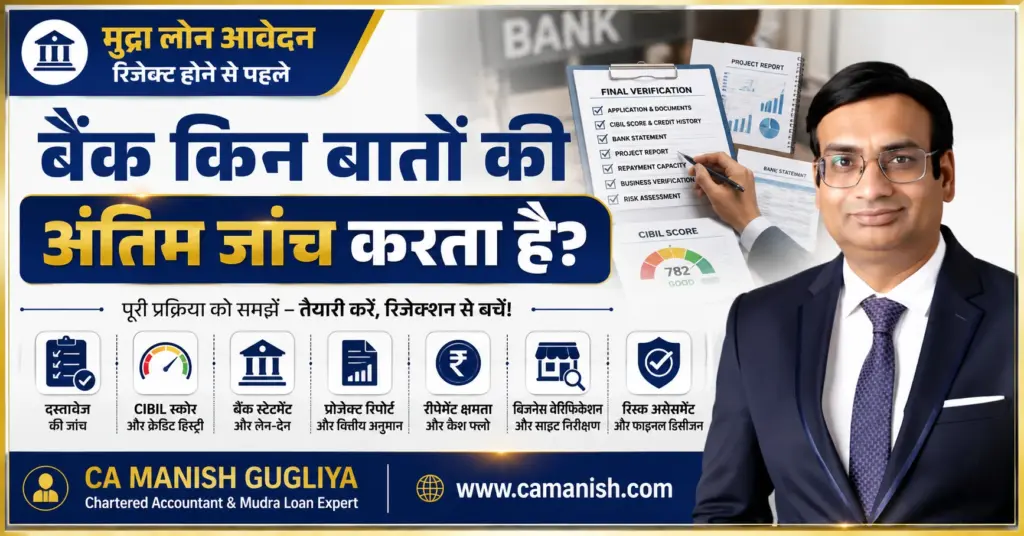
- मुद्रा लोन आवेदन रिजेक्ट होने से पहले बैंक किन बातों की अंतिम जांच करता है?
- मुद्रा लोन आवेदन की कौन-कौन सी गलतियाँ रिजेक्शन का कारण बनती हैं?
- अच्छा CIBIL Score होने पर भी मुद्रा लोन क्यों रिजेक्ट हो सकता है? (2026)
- मुद्रा लोन रिजेक्ट होने का असली कारण कैसे पता करें? पूरी गाइड (2026)

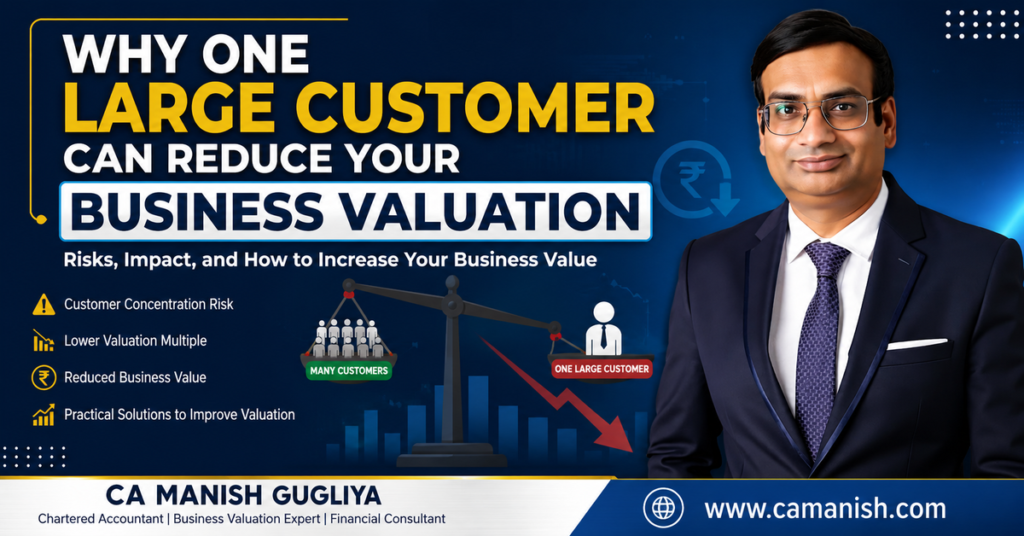
- Why One Large Customer Can Reduce Your Business Valuation (2026 Guide)
- How to Prepare Your Company for an SME IPO in India (2026): Practical Guide by a Chartered Accountant


- Why Investors Say “We Will Get Back to You” and Never Invest: 20 Hidden Reasons Startup Funding Deals Fail

- मुद्रा लोन से चाय की दुकान कैसे शुरू करें? – पूरी जानकारी
- मुद्रा लोन से ब्यूटी पार्लर खोलना: आकर्षक और प्रेरणादायक गाइड